
Why Literacy Matters
Literacy is a foundation for opportunity. It influences income and employment, health and longevity, civic engagement, and personal confidence. When someone can’t read well, it affects their entire life, making it difficult to find jobs, stay safe, and navigate critical services.
Many Illinois residents face barriers to literacy: poverty, limited access to education, and long-standing inequities. Because literacy challenges are often invisible and stigmatized, their impact is frequently underestimated. Communities with higher literacy are safer, more economically resilient, and more connected.
How Literacy Improves Lives and Strengthens Communities


Literacy in Illinois
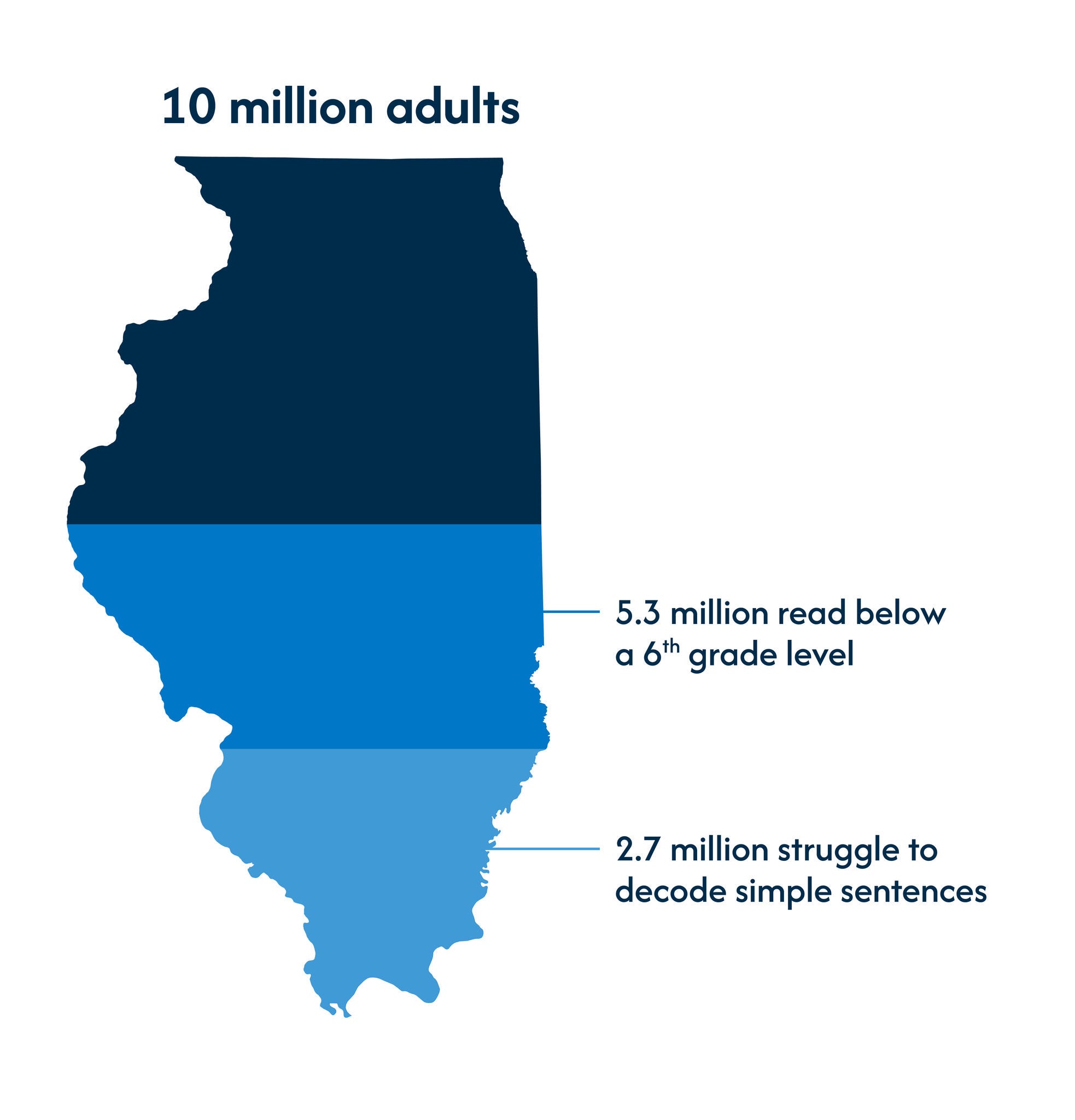
Over 2.7 million adults in Illinois aged 16 to 65 read below a third-grade level. This can make everyday tasks like reading instructions, filling out forms, or reading to their children difficult or impossible.
Additionally, almost twice that number — 5.3 million adults — struggle to make sense of paragraphs that contain multiple sentences.
Literacy Is an Equity Issue
Race
In the U.S., Black individuals are three times more likely than white individuals to struggle with reading (50% compared to 16%). Many Hispanic individuals also face similar challenges – with 45% demonstrating lower reading levels.
English Language Learning
According to the Illinois Department of Human Services, Illinois has about 1.8 million residents who are not native English speakers (14% of the state’s population). These individuals are twice as likely as native speakers not to have learned to read and write in English.
Poverty
Individuals and families whose incomes are below the federal poverty line are less likely to have access to quality education and resources that can help them improve their reading skills. The World Literacy Foundation reports that 43% of adults with low literacy levels live in poverty.
Geography
Some parts of the state are "literacy deserts,” meaning they don’t have literacy organizations, public libraries, or community colleges. It’s crucial to identify and address these unserved areas, both urban and rural.
Stigma
Many people feel ashamed about their struggles with reading and try to keep it a secret. It’s important to understand that struggling with reading isn’t a personal failure. With the right support, anyone can learn to read.
Contact Us
We're here to help and answer your questions about literacy in Illinois.